
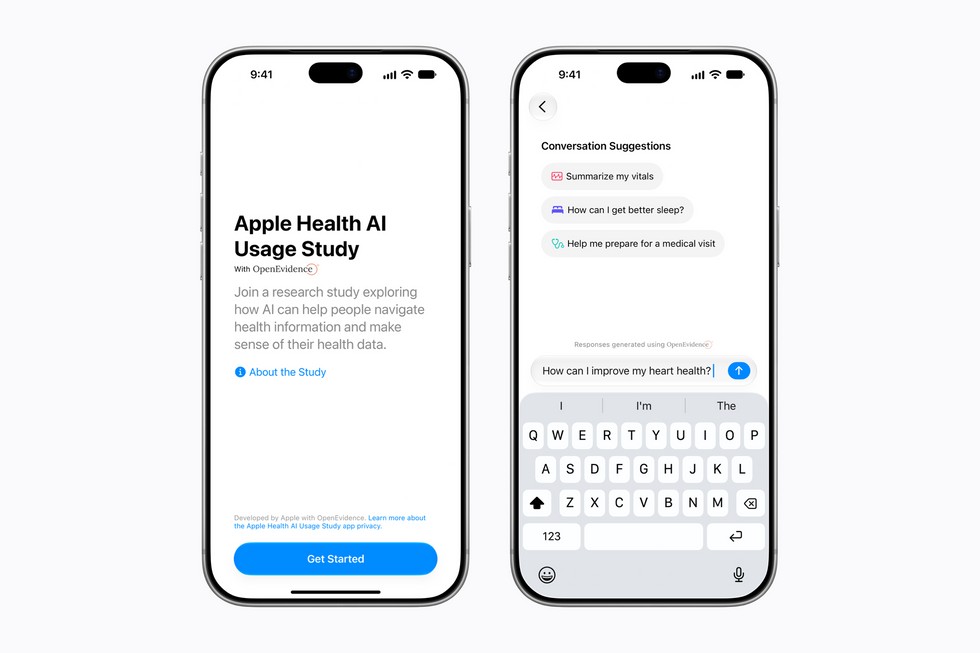
Apple has launched a research study to examine how people use conversational AI tools for health questions, the company said in a newsroom post on November 15. The Apple Health AI Usage Study is being run in collaboration with OpenEvidence, a clinical AI platform that Apple describes as widely used by healthcare professionals.
According to Apple, the virtual study and its companion app are meant to improve understanding of what drives user trust in health AI, the quality of responses, how well people comprehend them, and the everyday health actions they take afterward. Apple says the findings are intended to inform the responsible design of health AI experiences for the company and the wider industry.
What participants will do
Participants can ask the study app everyday health questions and explore complex medical information explained in approachable language. Responses come with linked, peer-reviewed clinical citations. OpenEvidence says its answers draw on sources such as The New England Journal of Medicine, the Journal of the American Medical Association and Nature. Apple adds that the study will also explore whether health AI can help people prepare for visits with their own doctors.
Participants may optionally share HealthKit data types, such as resting heart rate, activity, sleep or lab results, so researchers can look at how personal data affects relevance and understanding. Sharing HealthKit data and survey responses is optional, according to Apple.
Privacy and safeguards
Apple says the study was designed with privacy protections, transparency and clinical guardrails, and that study data will not be used to train AI models. The app includes safety guardrails intended to detect certain concerning questions and suggest that a participant follow up with a provider or other resources.
Sumbul Desai, Apple's vice president of Health and Fitness, said in the announcement that a dedicated research study is the most thoughtful way to understand how people engage with health AI. Robert M. Wachter, chair of the Department of Medicine at UCSF, also provided a comment, saying that connecting these tools and rigorously studying what works is how patients and clinicians can be better aligned.
Who can join
The study is open to up to 200,000 eligible participants in the United States who are 21 or older. Enrollment requires an Apple Intelligence-enabled iPhone, meaning an iPhone 15 Pro or later, running iOS 26 or later. Interested users can download the study app to learn more and choose whether to enroll.
Apple acknowledges in its announcement that consumer health tools powered by large language models can sometimes give incomplete or unclear answers, which it cites as the reason rigorous research is needed. The company did not give a timeline for results in the post.

0 comments